Your cultural identity, family history, and lived experiences influence how you see yourself, connect with others, and navigate emotional challenges. Therapy should make room for those experiences, not ask you to set them aside.
I offer culturally responsive therapy for BIPOC, immigrant, first-generation, and multicultural individuals navigating identity, family relationships, intergenerational trauma, and the emotional complexities of living between cultures.
My approach is collaborative, direct, and grounded in the understanding that your cultural background is part of your story—not something that needs to be fixed.
Appointments are subject to current availability. Therapy services are provided in Arizona.
For many individuals from immigrant and multicultural backgrounds, emotional challenges extend beyond the individual.
Family expectations, cultural obligations, community pressures, experiences of discrimination, and the desire to belong can influence how we understand our needs and relationships.
You may find yourself balancing respect for your family with the desire for independence, questioning expectations you grew up with, or navigating a sense of responsibility that feels difficult to put into words.
These experiences deserve to be explored with curiosity and cultural sensitivity, rather than reduced to symptoms or diagnoses.
I believe effective therapy requires more than applying a treatment model without considering the person receiving it.
My approach is trauma-informed, solution-focused, collaborative, and culturally responsive. I work with clients to identify patterns, understand their emotional experiences, and develop practical strategies that align with their goals and values.
I do not assume that independence is always the desired outcome, that family closeness is inherently unhealthy, or that cultural traditions must be abandoned for personal growth.
Instead, we explore what is meaningful to you, where difficulties arise, and how you can develop healthier relationships and boundaries while honoring the parts of your identity you wish to preserve.
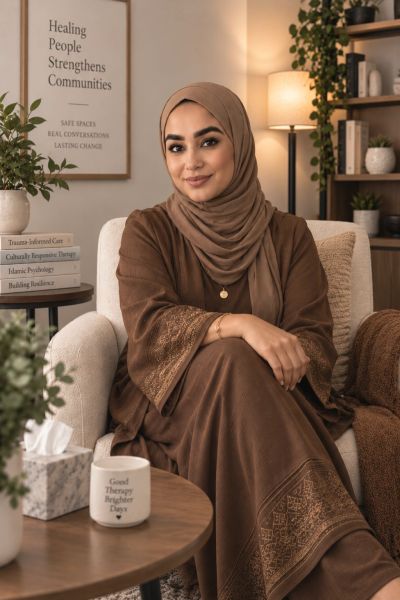

Having been born in Pakistan, raised in Southern California, and living within multiple cultural environments, I understand that identity is rarely confined to one community or set of expectations.
My personal experiences inform my appreciation for the complexities of migration, cultural belonging, family obligations, and the differences between individualistic and collectivist perspectives.
Alongside my clinical training in marriage and family therapy and trauma-informed care, these experiences shape how I approach conversations about identity, family relationships, emotional well-being, and cultural expectations.
You should not have to spend your entire therapy session explaining why your cultural background matters.
Caroline Clauss-Ehlers, PhD
Understanding how family histories, migration experiences, cultural traditions, and communication patterns influence present-day relationships, boundaries, and emotional well-being.
Exploring the experience of navigating multiple cultural worlds, including belonging, identity development, family responsibilities, and the pressure to meet competing expectations.
Making space for the complexities of balancing cultural traditions with personal values, especially when those experiences create conflict, guilt, uncertainty, or isolation.
Processing the emotional impact of racism, prejudice, stereotyping, exclusion, and other experiences that may affect safety, self-esteem, relationships, and trust.
Exploring communication, cultural expectations around marriage, family roles, emotional expression, and the challenges that arise when individual needs and collective values intersect.
Understanding how religious beliefs, community expectations, and cultural traditions may influence emotional well-being. For clients who wish to incorporate their faith, Islamic counseling can be integrated into therapy without assuming that every cultural or relational concern is religious in nature.
Please reach us at therapybyhumma@gmail.com if you cannot find an answer to your question.
No. My practice welcomes individuals from different backgrounds. This service emphasizes culturally responsive counseling for people whose identities, migration experiences, or family histories contribute to their current concerns.
Yes. I work with individuals and families navigating intergenerational differences, cultural expectations, communication difficulties, boundaries, and changing family roles. Family therapy participation depends on clinical appropriateness and availability.
Not necessarily. Culturally responsive therapy and Islamic counseling are distinct services. Cultural identity and religious beliefs may overlap, but they are not interchangeable. Faith can be incorporated into treatment when clients request it.